Blood in the Palace, Fire in the Hills
The Massacre That Killed a Dynasty and the Revolution That Consumed Itself
WHO CAPTURES THE GAINS?
Nepal's Hidden Power Game — A Four-Part Investigative Series
Synopsis
On June 1, 2001, ten members of Nepal's royal family were slaughtered in fifteen minutes. Four years later, Maoist guerrillas who started with two rifles controlled 80% of the country. These twin upheavals — one night of royal bloodshed and a decade-long civil war that killed 17,000 — didn't just reshape Nepal. They set the stage for everything that followed.
Nepal's modern political history pivots on two seismic events: the June 2001 royal massacre that eliminated a nationalist king and his family, and the Maoist insurgency that transformed from a two-gun guerrilla uprising into the country's largest political party before fragmenting into near-irrelevance. These events are deeply interconnected — the massacre removed the monarchy's most capable defender, while the Maoist movement's trajectory from revolutionary force to coalition-hopping parliamentary rump illustrates how armed movements are neutralized when absorbed into the systems they sought to destroy. Together, they reshaped a Himalayan kingdom into a federal republic, but left behind a trail of unanswered questions about who truly engineered Nepal's transformation — and for whose benefit.
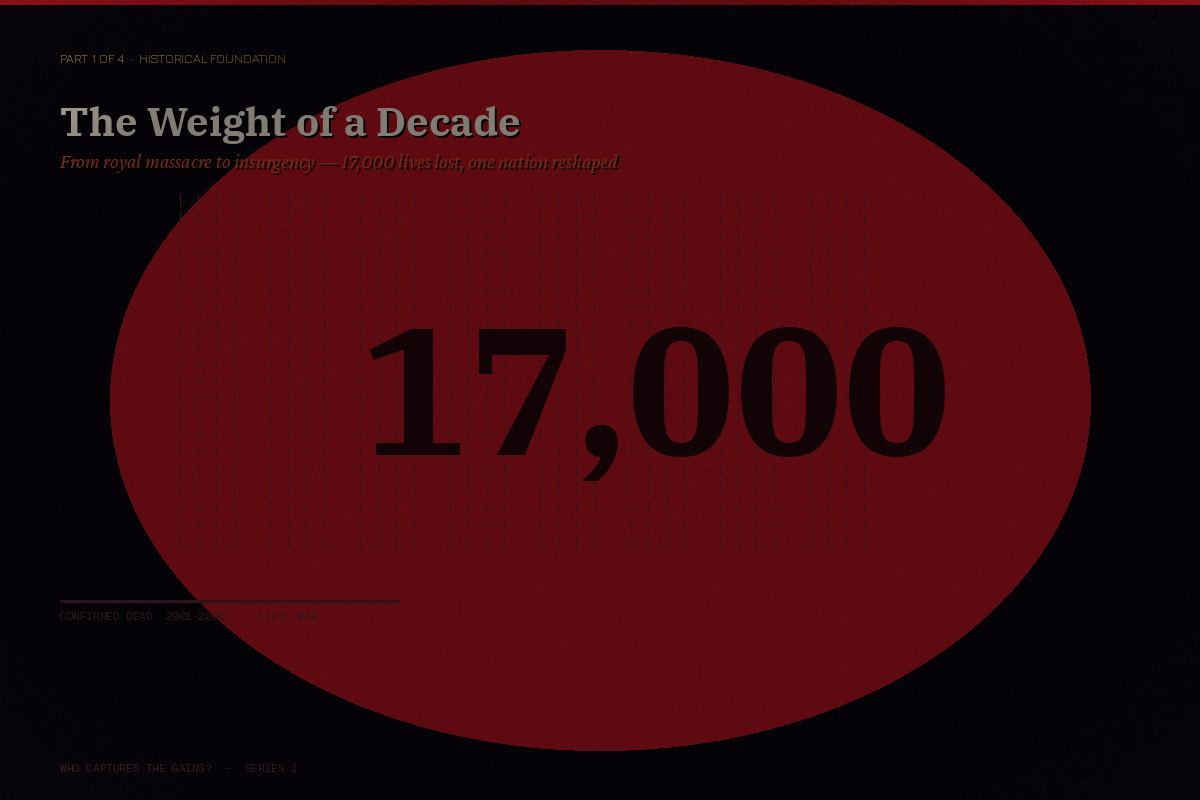
The death toll was staggering: 17,000 killed in the decade-long civil war, 10 royals slaughtered in a single night, and a 240-year monarchy erased. Yet the most consequential violence may have been invisible — the systematic dismantling of Nepal's communist movement through co-option, internal fragmentation, and external manipulation that reduced the party from 220 parliamentary seats to 32 in barely fourteen years.
Part One: The Maoist Movement
Two rifles, forty demands, and the longest night in Nepali history
On February 13, 1996, the Communist Party of Nepal (Maoist) launched the People's War with seven simultaneous attacks across six districts. The guerrillas who struck the Holeri police post in Rolpa carried one World War I-vintage .303 rifle and some knives. Al Jazeera later reported the entire movement possessed just two functional firearms — rifles originally supplied to Tibetan rebels by the CIA in 1961. From this improbable beginning, Pushpa Kamal Dahal ("Prachanda," meaning "the Fierce") and the party's chief ideologue Dr. Baburam Bhattarai would build an army that controlled 80% of Nepal's territory within a decade.
Nine days earlier, on February 4, Bhattarai had personally delivered a 40-point memorandum to Prime Minister Sher Bahadur Deuba at Singha Darbar. The demands fell into three categories — nationalism, democracy, and livelihood — and read as a catalogue of Nepal's structural injustices. They called for abrogation of the 1950 Nepal-India Treaty, a new constitution drafted by elected representatives, abolition of royal privileges, Nepal declared a secular state, land to the tillers, equal property rights for women, ethnic autonomy, and an end to caste-based exploitation. The deadline was February 17. Deuba left for India on February 11. The Maoists interpreted his departure as dismissal and attacked two days early. As Maoist leader Pampha Bhusal later admitted: "We knew the state was not capable of addressing our demands, so preparation for protracted people's war was underway even before we went to meet Deuba."
The insurgency drew its strength from Nepal's feudal reality. The top 6% of landholders controlled over 33% of agricultural land. Dalits — roughly 80% of the ultra-poor — endured bonded labor and systemic violence. Over 125 ethnic groups speaking 123 languages were governed by a state structure dominated by high-caste Parbatiya Hindu elites. Western hill districts like Rolpa and Rukum, the Maoist heartlands, lacked schools, roads, electricity, and medical facilities. The decade since democracy's 1990 restoration had produced over ten government changes and pervasive corruption, creating a legitimacy vacuum the Maoists filled with revolutionary promises and, increasingly, revolutionary coercion.
Ideologically, the CPN(M) adhered to Marxism-Leninism-Maoism and explicitly drew on Peru's Shining Path model through the Revolutionary Internationalist Movement (RIM). In 2001, they elevated "Prachanda Path" as their guiding doctrine — a fusion of Maoist protracted people's war adapted to Nepal's conditions. The Indian Naxalite movement provided both inspiration and operational links: Prachanda drafted war policies while residing in India, and in July 2001, regional Maoist groups formed CCOMPOSA (Coordination Committee of Maoist Parties and Organizations of South Asia), linking Nepali fighters with India's People's War Group and Maoist Communist Centre.
How guerrillas conquered the countryside while superpowers intervened
The government initially treated the insurgency as a police matter. The 30,000-strong Nepal Police, poorly trained and equipped, proved no match for guerrillas who systematically raided isolated posts, seizing weapons with each victory. Heavy-handed operations like Operation Romeo (1995) and Kilo Serra II drove more recruits into Maoist ranks than they eliminated. By 1998, the Maoists controlled 51 Village Development Committees and operated parallel governments with courts, schools, and taxation.
The June 2001 royal massacre changed the military calculus. King Gyanendra declared a state of emergency on November 26, 2001, deploying the Royal Nepal Army for the first time after the Maoists attacked army barracks in Dang District. The war escalated dramatically — 2002 alone produced roughly 5,000 deaths. By 2005, the People's Liberation Army had grown to approximately 30,000 combatants (including militia), with women constituting 20-40% of forces. The Maoists established the United Revolutionary People's Council under Bhattarai, operating as a parallel state across two-thirds of the country. The RNA retreated to fortified district headquarters, effectively ceding the rural landscape.
The human cost was devastating. Over 17,000 people were killed, with government forces responsible for an estimated 8,200 deaths and Maoists for over 4,000. Nepal experienced the world's highest rate of enforced disappearances during parts of the conflict, with approximately 2,500 people "disappeared." Between 100,000 and 200,000 were internally displaced. Both sides committed systematic abuses: the RNA engaged in summary executions, mass rape, and torture; the Maoists conducted forced recruitment (Human Rights Watch reported up to 30% of forces were children), extrajudicial killings of suspected informers, and the abduction of 8,777 individuals during the 2005 ceasefire alone.
American intervention escalated after September 11, 2001, as Washington framed the insurgency within its Global War on Terror. The Bush administration approved a $17-20 million military aid package, delivered thousands of M-16 rifles (estimates range from 5,000 initially to ultimately 17,000-20,000), established an Office of Defense Cooperation inside the embassy, and sent 49-member military expert teams for joint training. The RNA more than doubled in size with U.S. backing. Christina Rocca, Assistant Secretary of State for South Asia and former CIA officer (1982-1997), visited Kathmandu in December 2002 and publicly compared the Maoists to Pol Pot, the Cambodian dictator responsible for 1.5 million deaths. Her visit triggered the process of placing the CPN(M) on U.S. terrorist lists. Ambassador James Moriarty, dispatched in 2004 from the National Security Council (signaling White House-level management), took the hardest line of any foreign diplomat, consistently opposing accommodation with the Maoists.
India's role was profoundly contradictory. RAW (Research and Analysis Wing) maintained relationships with the Maoists even while India supplied INSAS rifles and attack helicopters to the Royal Nepal Army. Former RAW chief Ravi Sinha "operated inside Nepal to build this movement while stationed in Lucknow." Meanwhile, India's Intelligence Bureau helped arrest RAW asset Chandra Prakash Gajurel in West Bengal in 2003 — demonstrating the lack of coordination between India's own intelligence agencies. As one academic assessment noted, India "placed a bet on everyone in the race rather than just one horse," and deliberately backed Bhattarai as a counterweight to Prachanda to sharpen internal divisions.
The pivotal turn came with Gyanendra's February 1, 2005 royal coup, which alienated every political actor and caused the UK and India to suspend military aid. On November 22, 2005, the historic 12-point agreement was signed in New Delhi between the Seven Party Alliance and CPN(M), brokered by India. It declared "autocratic monarchy" the common enemy and committed both sides to constituent assembly elections. Former RAW chief PK H Tharakan personally facilitated the understanding. Prachanda declared it aligned with the original 40-point demand.
The 19-day Jana Andolan II (April 5-24, 2006) brought an estimated 4 million Nepalis into the streets, forcing Gyanendra to restore parliament. The Comprehensive Peace Agreement of November 21, 2006, formally ended the war, placed Maoist weapons under UN monitoring, and committed to constituent assembly elections. The revolution had achieved its immediate objectives — but the price of peace was the surrender of revolutionary capability.
The shock election and the republic's first breath
The April 10, 2008 Constituent Assembly elections produced what every analyst, embassy, and media outlet had deemed impossible: the Maoists won 220 of 575 elected seats, dwarfing the Nepali Congress (110) and CPN-UML (103). The result stunned the international community — all predictions had placed the Maoists third. Their grassroots mobilization, promises of land redistribution and ethnic inclusion, and aggressive organizational work through the Young Communist League delivered a mandate no one anticipated.
Eighteen days later, on May 28, 2008, the first session of the Constituent Assembly voted 560-4 to declare Nepal a Federal Democratic Republic, abolishing the 240-year Shah monarchy. Only the Rastriya Prajatantra Party opposed. Gyanendra was given 15 days to vacate the palace. On August 15, 2008, Prachanda was elected Prime Minister with 464 of 577 votes, forming a coalition with CPN-UML and the Madheshi Janadhikar Forum.
The combatant integration process revealed the gap between revolutionary aspiration and political reality. UNMIN verified 19,602 combatants in cantonments. A leaked 2009 video showed Prachanda admitting he had inflated these numbers. Under the November 2011 seven-point deal, combatants were offered integration, voluntary retirement, or rehabilitation. Of those who initially chose integration, only approximately 1,422 were actually absorbed into the Nepal Army — placed in a separate directorate limited to disaster relief and conservation, not combat. The vast majority took cash payments of NPR 500,000-800,000 and walked away. By April 2012, the PLA's weapons were surrendered and its cantonments closed. The Maoists' armed leverage was permanently eliminated.
From 220 seats to 32: anatomy of a political collapse
The decline was as dramatic as the rise. Prachanda's first government lasted just nine months — he resigned on May 4, 2009, after President Ram Baran Yadav blocked his attempt to sack Army Chief Rookmangud Katawal, who had refused to integrate Maoist combatants. This crisis crystallized the fundamental tension: the state's institutions, backed by India and the establishment, would not yield to Maoist demands for structural transformation.
What followed was organizational disintegration. In June 2012, Mohan Baidya ("Kiran"), Prachanda's own political mentor, split the party, taking 45 of 149 central committee members. Baidya accused the leadership of "destroying the achievements of the People's War" and called the peace process a surrender to "national and international power centres out of greed of power." Netra Bikram Chand subsequently split from Baidya in November 2014, forming an underground faction that carried out bombings. Most devastatingly, Baburam Bhattarai, the party's intellectual architect, left on September 26, 2015, declaring "yesterday's Maoist movement will not be able to address the aspirations of the new generation."
The electoral trajectory tells the story in numbers:
- 2008: 220 seats (largest party)
- 2013: 80 seats (third place — a catastrophic 64% decline)
- 2017: 53 seats (in alliance with UML)
- 2022: 32 seats (12.68% of proportional vote)
The 2013 crash resulted from governance failures (four years without producing a constitution), the Baidya split, loss of revolutionary credibility through entry into establishment politics, and voter punishment for political instability. Higher turnout (78% versus 60% in 2008) also diluted the Maoist base.
In May 2018, Prachanda merged with K.P. Sharma Oli's CPN-UML to form the Nepal Communist Party (NCP), holding 174 combined seats — a near two-thirds majority. The power-sharing agreement collapsed when Oli reneged on rotating the premiership. The Supreme Court voided the merger on March 8, 2021, ruling the NCP name was already registered to another party, and the constituent parties were revived.
Prachanda's third premiership (December 2022 - July 2024) exemplified his transformation from revolutionary to political operator. With only 32 seats, he leveraged a hung parliament, switching alliance partners between CPN-UML and Nepali Congress three times in 19 months and facing five confidence votes. He was finally ousted on July 12, 2024.
Following the extraordinary September 2025 Gen-Z uprising — in which at least 72-76 young protesters were killed by security forces, parliament was torched, and PM Oli was forced to resign — ten communist parties merged on November 5, 2025, forming a new Nepali Communist Party with Prachanda as coordinator. Elections are set for March 5, 2026. The party that once controlled 80% of Nepal's territory now enters the contest as one of several forces in a fragmented landscape.
The personal toll: Jamim Shah, Prakash Dahal, and the price of power
Two events in Prachanda's personal orbit have fueled theories about external pressure on Nepal's Maoist leadership, though neither has been conclusively linked to political intimidation.
Jamim Shah, Nepal's cable television pioneer and founder of Space Time Network and Channel Nepal, was shot dead on February 7, 2010, in broad daylight in Lazimpat, Kathmandu — the same neighborhood where Prachanda's family resided. Two masked gunmen on a motorcycle fired twice into his head and once into his chest. Shah operated at the nexus of media, business, and the underworld. Police linked him to Dawood Ibrahim's D-Company; testimony from associates revealed he managed gold shipments from Dawood's brother Anees Ibrahim. The investigation led to 18 arrests, including three police officers, and identified Indian underworld don Bablu Shrivastav (jailed in Lucknow) as the mastermind. Most chillingly, another underworld figure, Bhagwant Singh, publicly confessed: "We killed Jamim. This will be the fate of anyone who stands against India." Bhagwant Singh was himself later assassinated. The gold smuggling network intersected with Maoist party finances — senior leaders including Vice Chairman Krishna Bahadur Mahara were linked to smuggling operations — but no verified evidence directly connects Shah's murder to a specific warning against Prachanda.
Prakash Dahal, Prachanda's 36-year-old son and personal secretary, was found dead on November 19, 2017, at the family's Lazimpat home. His mother discovered him unconscious at approximately 5 AM; doctors estimated he had been dead for roughly three hours. The official cause was sudden cardiac arrest. No autopsy was performed, and his body was cremated the same day at Pashupati Aryaghat. The death occurred two weeks before Nepal's critical first provincial and parliamentary elections, during which Prachanda was forging the historic Left Alliance with Oli. The absence of an autopsy, the rapid cremation, and the young age of the deceased are noteworthy, but no mainstream investigation has established foul play.
Prachanda has endured extraordinary family losses: his eldest daughter Gyanu KC died of breast cancer in 2014; his wife Sita Dahal died in July 2023 after years of progressive neurological disease that worsened after their children's deaths. During the September 2025 Gen-Z protests, his residences in Khumaltar and Chitwan were looted and set ablaze. Whether these tragedies represent targeted intimidation or cruel coincidence remains genuinely unresolvable with available evidence. What is observable is Prachanda's progressive transformation from revolutionary commander to the most prolific coalition-hopper in Nepali history — a trajectory that hardline defectors like Baidya and Chand explicitly attribute to co-option by establishment forces.
The co-option thesis: how revolutions die in committee rooms
The argument that Nepal's Maoist movement was systematically neutralized through mainstreaming rather than military defeat rests on substantial circumstantial evidence. Scholar S.D. Muni's Cambridge University Press chapter "Bringing the Maoists Down from the Hills" describes India's strategy of shifting from supporting the monarchy against the insurgency to favoring an alliance between the Maoists and political parties — a calculated move to bring revolutionaries into a controllable parliamentary framework rather than risk a revolutionary victory.
India's strategic calculus was driven by the Naxalite threat. The CPN(M) had operational links with Indian Maoist groups across the "Red Corridor" that PM Manmohan Singh called "the single biggest internal security challenge." CCOMPOSA coordinated cross-border activities; the Indo-Nepal Border Regional Committee jointly operated in Bihar; weapons and personnel freely transited the 1,850-kilometer open border. A Maoist-governed Nepal would have provided sanctuary, logistical support, and ideological momentum to Indian insurgents — an existential concern for New Delhi.
The mechanisms of weakening are well-documented. The peace process stripped the Maoists of armed capability through combatant integration/retirement. Internal splits — likely encouraged but not necessarily directed by external forces — fragmented the party into at least eight factions. Corruption corroded revolutionary credibility as leaders accumulated the perquisites of power. The pattern replicates globally: FARC in Colombia, the Sandinistas in Nicaragua, the ANC in South Africa — revolutionary movements consistently lose radical energy upon entering the systems they opposed.
RAW's role was sophisticated and multi-layered. India simultaneously maintained dialogue with the Maoists, arrested their leaders for leverage, encouraged moderates as counterweights to hardliners, and manipulated incentive structures until "a transformation in behaviour which suited the establishment" occurred. The 12-point agreement was India's architecture; the peace process was India's design; the outcome — a fragmented, weakened communist movement within a liberal democratic framework — served India's interests whether or not it was fully planned.
The "Prachanda doctrine" allegation — that he was turned by RAW — is politically instrumentalized across Nepal. Former intelligence officer Rishi Raj Baral publicly alleged in 2011 that both Bhattarai and Prachanda were part of an Indian plot. Prachanda spent eight of his ten underground years in India and is "widely believed" to have received RAW sanctuary. Yet these accusations should be treated cautiously: RAW allegations are weapons deployed by every faction against every opponent in Nepali politics, and Indian officials have been "amused by the outrageousness of the allegations."
What is analytically clear is that bringing the Maoists into government was the most effective counterinsurgency strategy ever deployed against them — more devastating than M-16 rifles or state of emergency declarations. The revolution consumed itself in committee rooms.
Part Two: The Royal Massacre
Fifteen minutes of gunfire that destroyed a dynasty
On the evening of June 1, 2001, approximately 24 members of the Shah royal family gathered for their customary monthly dinner at the Tribhuvan Sadan within Narayanhiti Palace, hosted by Crown Prince Dipendra. No guards or outsiders were permitted at these intimate gatherings. Dipendra arrived early and drank heavily — Famous Grouse whisky, neat — before playing billiards alone. Between 8:12 and 8:39 PM, he made three phone calls to his girlfriend Devyani Rana, the last ending with "I am now about to sleep. Good night."
He did not sleep. At approximately 8:19 PM, he had ordered his ADC to bring a cigarette laced with hashish and a mysterious "unnamed black substance." After being found swaying and incoherent by four relatives, he was escorted to his bedroom. Servants heard retching from the bathroom. Then, instead of resting, Dipendra changed into army combat fatigues — camouflage jacket, black boots, leather gloves, camouflage vest — and emerged carrying weapons.
At approximately 9:00 PM, he entered the billiard hall and opened fire with a 9mm HK MP5K submachine gun, spraying the ceiling and wall before turning the weapon on King Birendra. He exited, discarded a SPAS-12 shotgun, re-entered with a 5.56mm Colt M-16 A2 rifle, and fired again at the King, then at Prince Dhirendra (who tried to intervene and was shot at point-blank range), Kumar Gorakh, and Kumar Khadga. On a third entry, he shot Princesses Shruti, Sharada, Shanti, and Jayanti. Prince Paras pulled a sofa over at least three royals, including two children, saving their lives.
Queen Aishwarya, identifiable by her red sari, chased after Dipendra toward the garden. Prince Nirajan followed. Both were shot dead near a staircase — brain tissue, teeth, and jawbone fragments were found at the location. Dipendra then shot himself in the left temple — despite being right-handed — and was found lying on his back, gurgling, beside a pond.
Seventy-eight confirmed rounds were fired across three weapons (47 from the M-16, 29 from the MP5K, 2 from a Glock 19). The entire massacre lasted approximately 15 minutes.
Ten people died. King Birendra (55), Queen Aishwarya, Prince Nirajan (22), Princess Shruti (25), Princess Shanti, Princess Sharada, Princess Jayanti, Kumar Khadga Bikram Shah, and Prince Dhirendra (who survived three days). Dipendra himself, declared King while comatose on June 2, died on June 4, 2001, at 3:45 AM. Five people survived with serious injuries, including Gyanendra's wife Queen Komal. Every member of King Birendra's and Crown Prince Dipendra's immediate families was killed or dying. No one in Gyanendra's family died.
An investigation designed to fail
King Gyanendra formed a two-member investigation committee on June 4 — Chief Justice Keshav Prasad Upadhyaya and House Speaker Taranath Ranabhat. CPN-UML leader Madhav Kumar Nepal resigned from the panel on June 6, calling it unconstitutionally organized by the palace rather than parliament. The committee interviewed over 100 people, worked for approximately one week, and submitted a 53-page report on June 14 concluding that Dipendra was solely responsible.
The investigation's deficiencies were extraordinary for a case involving the murder of an entire royal family. No autopsies were performed. Bodies were cremated within 24 hours. Scotland Yard's offer of forensic assistance was rejected without explanation. No bullet trajectory analysis was conducted. No toxicology reports were produced. The crime scene was cleaned within days; the Tribhuvan Sadan was demolished entirely in 2005 on Gyanendra's orders. The committee had no prosecutorial power and, under sovereign immunity, Dipendra could not have been charged regardless.
At least two survivors publicly confirmed Dipendra as the shooter in a BBC documentary. ADC Gajendra Bohara provided detailed testimony confirming the sequence of events. But former ADC Vivek Kumar Shah directly told Gyanendra that the investigation focused only on what happened, not why — "This part has not been investigated."
One dissenting voice emerged years later. Hawaldar Lal Bahadur Lamteri Magar, Dipendra's bodyguard, told Naya Patrika newspaper in 2008 that the first shots were heard while Dipendra was resting, that Dipendra was killed before everyone else, and he directly accused Prince Paras as the perpetrator. Four soldiers filed a supporting petition. Magar was subsequently arrested and charged with murder in an unrelated case — his detention raised suspicions of politically motivated silencing.
Why Nepal doesn't believe its own government
Public rejection of the official narrative is nearly universal, driven by specific evidentiary problems and the extraordinary convenience of the outcome for one branch of the royal family.
The physical evidence contradictions are significant. Dipendra was right-handed; his fatal wound was to his left temple. He was described as so intoxicated he was "falling and stammering" and had to be carried to bed, yet allegedly changed into combat gear, armed himself with four weapons, and executed a precise tactical massacre against a room full of people. The "unnamed black substance" he smoked was never identified — possibly opium, cocaine, or heroin. Former Indian Ambassador K.V. Rajan's 2024 book suggests Dipendra was supplied "personality-changing drugs" through Pakistan's ISI and Dawood Ibrahim's network, though this theory conveniently redirects blame away from India.
The Gyanendra-Paras survival pattern is the conspiracy theories' strongest foundation. Gyanendra was the only senior male royal absent — in Pokhara or Chitwan attending conservation meetings. Paras was present but barely injured. The entire succession line between Gyanendra and the throne — both Dipendra and Nirajan — was eliminated. Gyanendra's initial claim that deaths resulted from "an accidental discharge of an automatic weapon" was a transparent falsehood that destroyed his credibility. Former PM Girija Prasad Koirala himself stated: "I also thought the King, Gyanendra, was involved in the royal massacre, and he was the master planner."
Prince Paras's notorious reputation made suspicions of his involvement more plausible. In August 2000, his vehicle struck and killed popular folk singer Praveen Gurung — over 600,000 signed petitions demanding charges, but an army officer claimed responsibility instead. He had previously jammed a gun into a police officer's eye. A 2002 U.S. Embassy cable described him as "widely despised." He was later arrested multiple times in Thailand for marijuana possession and property destruction.
Alternative theories include: Gyanendra orchestrating the killings for succession (most widely believed); masked assassins impersonating Dipendra; a conspiracy involving Paras, Dr. Rajiv Shahi, and army generals to eliminate the "liberal camp"; RAW or CIA involvement; ISI/Dawood Ibrahim instigation; and palace security guards as the actual shooters. None has been proven. The official account, supported by multiple named eyewitnesses whose stories broadly align, remains the most evidence-supported version — but the investigation's catastrophic failures ensure the questions will never be fully resolved.
Birendra the nationalist versus Gyanendra the autocrat
The geopolitical dimension transforms the massacre from family tragedy into potential statecraft. King Birendra had pursued a distinctly independent foreign policy that repeatedly frustrated India. At the 1973 Non-Aligned Movement summit, he proposed Nepal as a "Zone of Peace" — an initiative supported by 116 countries including China, the US, UK, France, and Pakistan. India refused to support it, viewing it as a potential repudiation of the 1950 treaty establishing Indian dominance.
Birendra balanced meticulously between India and China, expanding Nepal's diplomatic relations from 49 to 96 countries. He initiated SAARC, conducted a state visit to the United States in 1983 (no Nepali leader has since), and negotiated independently on arms procurement — planning to manufacture firearms in Nepal, bypassing Indian pressure to buy INSAS rifles. Critically, when India demanded Nepal grant citizenship to millions of Indian-origin Terai residents, Birendra rejected the bill — legislation that was later passed only after the monarchy's abolition.
India had already punished Birendra's independence with a devastating economic blockade in 1989, closing 19 of 21 border crossings. Maoist leader Bhattarai wrote after the massacre that its purpose was "to replace a patriotic king with one who would do India's bidding," praising Birendra's role in preserving sovereignty. Pakistani Lieutenant General Javed Nasir stated: "India is the main conspirator behind the Nepalese royal family massacre as it had warned the family not to get too close to Pakistan and China."
If India expected a more pliable successor, the calculation backfired spectacularly. Gyanendra proved more authoritarian, not less. On February 1, 2005, he executed a full coup d'état: dismissing the government, dissolving parliament, severing telecommunications, grounding flights, arresting political leaders, and imposing complete media censorship. His crackdown produced 599 deaths in the first 100 days. India called it "a serious setback to the cause of democracy"; the US suspended $1.5 million in military assistance; the UK froze military aid. Nepal lost over 4 billion rupees ($57 million) in foreign aid.
The 19-day Jana Andolan II in April 2006 forced Gyanendra to restore parliament. On May 28, 2008, the Constituent Assembly voted to abolish the monarchy. Gyanendra vacated the palace and retreated to private life as a wealthy businessman with an estimated net worth of $600-900 million — stakes in Soaltee Hotel, Himalayan Goodricke Tea, Surya Nepal Tobacco, and various enterprises. He has since made cautious political moves: attending Hindu nationalist events, making statements interpreted as monarchy restoration calls, and receiving reverent treatment from BJP's Yogi Adityanath during visits to India. Pro-monarchy protests have intensified — a March 2025 demonstration drew 10,000 supporters, while a March 28 protest turned violent, killing two people including a journalist. Yet constitutional restoration requires a two-thirds parliamentary majority; the monarchist RPP holds only 14 of 275 seats.
The grand design: connecting massacre to revolution to republic
The most provocative analytical framework treats the massacre and the Maoist trajectory as components of a single geopolitical transformation. The alleged sequence proceeds: remove nationalist king → install controversial successor → king overreaches → justify republic → bring Maoists into the system → co-opt and weaken communist movement → establish a liberal democratic framework friendly to India and the West.
Several elements of this framework are well-documented. India's RAW did facilitate the 12-point agreement that brought Maoists into mainstream politics. India did work to ensure the Maoists were neutralized through parliamentary absorption rather than defeated militarily. The Naxalite connection did provide a genuine strategic motive for India to defang Nepal's communists. The outcome — a fragmented political landscape with weak coalition governments — does serve Indian interests by preventing any single Nepali political force from accumulating enough power to resist Indian influence.
But the framework's weakest link is its first step. No smoking-gun evidence connects any foreign intelligence service to the palace massacre. The geopolitical motive is plausible for India (removing an independent monarch), but the counter-evidence is significant: Gyanendra proved worse for Indian interests than Birendra, requiring another decade of intervention to achieve the republic. The ISI/Dawood theory proposed by former Indian Ambassador Rajan conveniently redirects blame. CIA involvement claims are speculative. The official Dipendra narrative, while unsatisfying, is supported by multiple named eyewitnesses.
If Birendra had lived, the trajectory might have been fundamentally different. He was already considering talks with the Maoists — PM Koirala sought army deployment against the insurgency, but Birendra resisted. His democratic legitimacy and public reverence could potentially have brokered a peace deal while preserving the monarchy. The first peace talks began just two months after the massacre, suggesting the framework for negotiation already existed.
What can be stated with analytical confidence is this: the massacre created the conditions for everything that followed. It removed the monarchy's most capable and legitimate defender, installed a successor whose autocratic temperament guaranteed institutional overreach, provided the justification for republicanism, and opened the path for the Maoist movement's absorption into — and destruction within — the parliamentary system. Whether this was design or consequence remains the central unresolved question of modern Nepali history.
Conclusion: The Revolution That Devoured Its Children
Nepal's twin upheavals illustrate a pattern visible across the Global South: nationalist leaders who resist great-power dominance are vulnerable to removal, and revolutionary movements that enter parliamentary politics are vulnerable to absorption and fragmentation. The Maoist trajectory from two rifles to 220 seats to 32 seats represents one of modern history's starkest political declines — achieved not through military defeat but through the more insidious mechanism of mainstreaming. The royal massacre remains genuinely unresolved, its investigation so catastrophically inadequate that definitive conclusions are impossible — which may itself have been the point.
As Nepal approaches its March 2026 elections, the newly merged Nepali Communist Party enters under Prachanda's coordination — the same leader who launched the People's War 30 years earlier with borrowed rifles. The monarchy's ghost stirs through Gyanendra's symbolic appearances and growing pro-restoration protests. India's open border remains the invisible architecture of Nepali politics. And the 17,000 dead of the civil war, the 10 royals of that June night, and the 72 young protesters of September 2025 form a collective reckoning that Nepal has yet to confront — a truth and reconciliation process promised in 2006 and still undelivered two decades later.
The pattern that emerges from three decades of evidence is not a single conspiracy but something more complex: an ecosystem of external manipulation, internal ambition, structural vulnerability, and historical contingency in which India, the United States, Britain, and Nepal's own political class each played roles — sometimes coordinated, often contradictory, and collectively devastating. Nepal's political transformation was real. Whether it was ever truly Nepal's own remains the question its people are still asking.
COMING NEXT: PART 2 OF 4 — The Invisible Architecture
In Part 2, we trace how the 2015 Indian blockade and $900 million in American democracy funding built the invisible infrastructure that would reshape Nepal's politics for a decade.