The Five-Day Revolution
Gen Z, Shattered Coalitions, and the Fight for 2026
WHO CAPTURES THE GAINS?
Nepal's Hidden Power Game — A Four-Part Investigative Series
Synopsis
On September 4, 2025, Nepal's government banned 26 social media platforms. Five days later, parliament was on fire, the Supreme Court was in ashes, and the Prime Minister had fled to an army barracks. Seventy-six young people were dead. Nepal had its first female PM, a dissolved parliament, and an election that would determine everything. This is the story of the uprising, the players who emerged from the wreckage, and the battle lines for March 2026.
◀ Previously in this series
In Part 2, we documented how India and the US spent a decade building the infrastructure that would channel Nepal's political energy in one direction. Read Part 2 →
Nepal stands on the cusp of its most consequential election in a generation, scheduled for March 5, 2026, after a youth-led uprising in September 2025 toppled the government, burned parliament, and forced the country's first female prime minister into power. The September 2025 Gen Z protests — now officially designated Janaandolan III (Third People's Movement) — killed at least 76 people and fundamentally reshaped the country's political landscape. Communist parties that dominated governance for nearly two decades face an existential reckoning, not because of a systematic foreign conspiracy, but because of their own corruption, factionalism, and a youth population that has lost all patience. With 18.9 million voters, over 900,000 first-time Gen Z registrants, and 120+ parties contesting, Nepal's March election will determine whether the old guard survives or a new political generation truly takes power.
Three Revolutions, One Recurring Betrayal
Nepal's political history moves in dramatic lurches. Janaandolan I (1990) overthrew the Panchayat autocracy after 49 days of protests and restored multiparty democracy. Janaandolan II (2006) ended King Gyanendra's direct rule in 19 days and ultimately abolished the monarchy by 2008. Both movements shared a pattern: ordinary citizens bled for change, and political elites harvested the gains. After 1990, the democratic parties "perfected a kleptocratic system" that bred the Maoist civil war. After 2006, Maoist commanders became ministers presiding over the same corrupt apparatus they had fought to destroy.
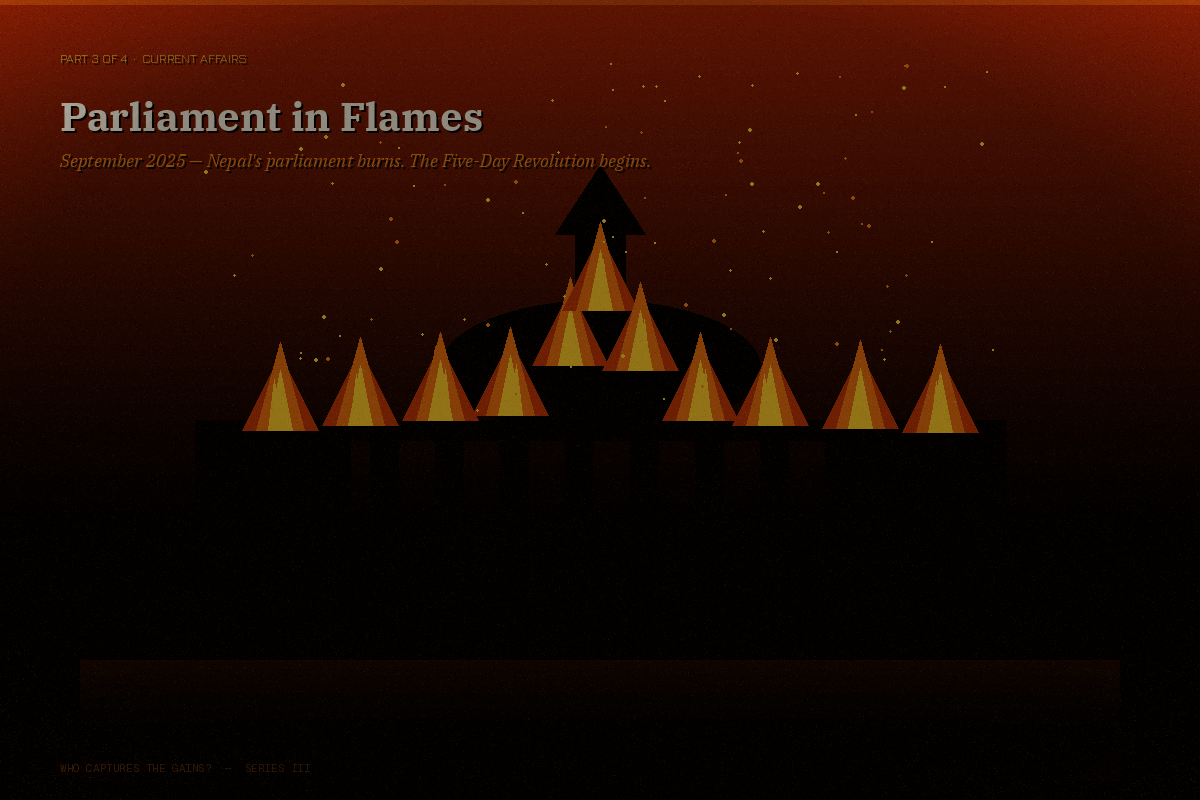
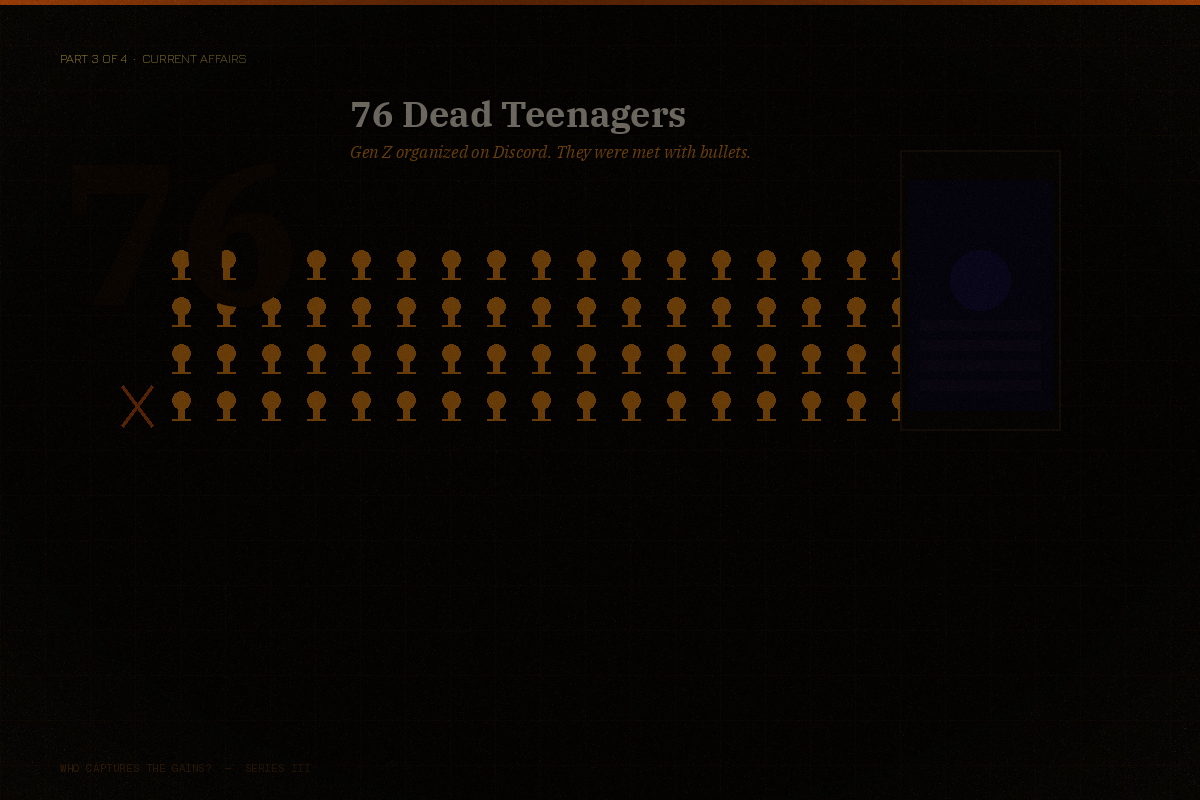
Janaandolan III arrived in just five days. On September 4, 2025, PM KP Sharma Oli's government banned 26 social media platforms — Facebook, YouTube, WhatsApp, X, Instagram, Reddit, Signal — ostensibly for failing to register under new digital rules. The real trigger was the viral #NepoKids movement, where young Nepalis on TikTok exposed the obscene lifestyles of politicians' children against a backdrop of 20.8% youth unemployment and 1,500 Nepalis leaving daily for foreign labor. On September 8, tens of thousands of teenagers in school uniforms marched on parliament. Security forces responded with live ammunition, rubber bullets, and tear gas — firing 2,642 live rounds and 1,884 rubber rounds over two days. A 12-year-old student was among the 19 killed on the first day alone. By September 9, enraged crowds set fire to parliament, the Supreme Court, Singha Durbar (the PM's office), and the private homes of Oli, Deuba, and Prachanda. Oli fled to an army barracks and resigned. On September 12, Sushila Karki — a former Chief Justice chosen by protesters through a Discord server poll — was sworn in as Nepal's first female head of government. Parliament was dissolved. Elections were called.
The hijacking narrative is already repeating. Protest organizer Anil Baniya of Hami Nepal explicitly stated that what began as a peaceful movement was "hijacked by external forces and political party cadres." The movement's leaderless, decentralized character — organized through Discord servers with 100,000+ members — was its greatest strength and its greatest vulnerability. As one Nepali professor warned: "We must never again outsource hope, agency or critical thinking to any self-proclaimed saviour."
The Coalition Carousel That Broke Nepal's Patience
To understand why Gen Z erupted, one must follow the dizzying coalition arithmetic that defined 2022–2025. The November 2022 elections produced a fractured parliament: Nepali Congress won 89 seats (the largest bloc), CPN-UML took 78, CPN-Maoist Centre won 32, and the brand-new Rastriya Swatantra Party stunned the establishment with 20 seats. Despite his party finishing third, Pushpa Kamal Dahal "Prachanda" became PM by assembling a coalition with UML and RSP — then proceeded to survive five confidence votes across 19 months by constantly switching allies.
The sequence was exhausting. Prachanda governed first with UML (December 2022–February 2023), then switched to Congress (March 2023–March 2024), then switched back to UML (March 2024–July 2024). Each switch was purely transactional — driven by disputes over presidential nominations, cabinet reshuffles, and patronage. In July 2024, UML's Oli and Congress's Deuba struck a "midnight deal" for a rotational premiership: Oli would govern first for roughly 1.5 years, then hand power to Deuba. Prachanda lost his fifth confidence vote (63 for, 194 against) and was ousted. KP Sharma Oli was sworn in as PM for the fourth time on July 15, 2024, backed by a UML-Congress supermajority of 165+ seats.
Oli governed for barely 14 months before the Gen Z protests ended his tenure. His government's actions — the social media ban, the firing of the popular technocrat Kulman Ghising from the Nepal Electricity Authority in March 2025, and escalating authoritarian tendencies — destroyed whatever legitimacy the UML-Congress coalition had. The rotational deal that was supposed to guarantee Deuba's eventual turn as PM never materialized. Instead, both traditional powerhouses were consumed by the same fire.
Rabi Lamichhane, Balen Shah, and the New Political Generation
The most dramatic disruptors in Nepali politics are Rabi Lamichhane and Balendra "Balen" Shah — two outsiders who have merged forces to challenge the entire establishment.
Rabi Lamichhane was Nepal's most famous television journalist, known for his confrontational show Sidha Kura Janata Sanga ("Straight Talk with the People") where he publicly grilled corrupt officials. He held a Guinness World Record for the longest continuous TV broadcast (62+ hours). A former US citizen who renounced his American passport, Lamichhane founded the Rastriya Swatantra Party (RSP) in June 2022 — just five months before elections — and won 20 seats on an anti-corruption platform, making RSP the fourth-largest party overnight. He served twice as Deputy PM and Home Minister under Prachanda, both tenures cut short: the first when the Supreme Court invalidated his citizenship (January 2023), the second when the coalition collapsed (July 2024).
His legal troubles are severe. Lamichhane faces fraud, organized crime, and money laundering charges across five districts, all connected to cooperative scams that allegedly funneled depositors' money into his media company, Gorkha Media Network. He was arrested in October 2024, spent 84 days in detention before getting bail, was re-arrested in April 2025, and was freed from prison by protesters during the September 2025 uprising (he voluntarily returned to jail four days later). He was finally released on bail of Rs 37.4 million in December 2025. Critically, he has not been convicted and remains legally eligible to contest elections. His supporters view the cases as politically motivated; critics see them as evidence of the very corruption he claimed to fight.
Balen Shah is an even more improbable figure — a 35-year-old structural engineer and rapper who won the Kathmandu mayorship in May 2022 as a fully independent candidate, defeating Nepali Congress and UML nominees by over 23,000 votes. As mayor, he live-streamed municipal meetings, demolished illegal structures, and became a Time Magazine Top 100 honoree. His controversies were real — street vendor crackdowns criticized by Human Rights Watch, clashes with the central government over appointments, and an authoritarian streak. But his appeal to young voters as a symbol of anti-establishment competence remained potent.
On December 28, 2025, Balen Shah and Lamichhane signed a seven-point unity agreement: Shah became RSP's prime ministerial candidate while Lamichhane remained party chair. Kulman Ghising — the wildly popular engineer who ended Nepal's chronic power outages and was sacked by Oli — briefly joined the alliance before his Ujyaalo Nepal Party split away to contest independently. RSP is fielding candidates in 164 of 165 constituencies, and Shah is directly challenging Oli in his stronghold of Jhapa-5 — the marquee contest of the election. Whether two "larger-than-life" personalities can coexist long-term is an open question analysts are watching closely.
Gagan Thapa Bets on Generational Change Within Congress
Gagan Thapa is not currently PM — that role belongs to interim PM Sushila Karki — but the 49-year-old has positioned himself as Nepali Congress's answer to the Gen Z wave. After the September protests discredited the old guard, Thapa leveraged his reformer image to seize the party presidency from 79-year-old Sher Bahadur Deuba at a special convention in January 2026, surviving an internal attempt to expel him. He was declared Congress's PM candidate for the March election.
Thapa's Janakpur Declaration (February 18, 2026) attempted to reposition Congress as a reformed party, including a public apology to Gen Z youth and a "10-point Contract with the People." He is contesting from Sarlahi-4 in Madhesh Province rather than his traditional Kathmandu seat — a deliberate signal of outreach to the Terai. Congress enters the election as the dissolved parliament's largest party (88 seats at dissolution) and swept the January 2026 National Assembly elections in alliance with UML, winning 25 upper house seats. The party's structural advantages — decades of grassroots organization, name recognition, and institutional memory — remain formidable, but its association with the failed Oli coalition and chronic corruption weakens its reform messaging. Notably, over 52% of Congress tickets went to Khas-Arya males, with Dalit representation at a dismal 0.6%.
Communist Parties Face an Existential Test, Largely Self-Inflicted
The narrative that communist parties are being systematically sidelined deserves careful examination. The evidence is more nuanced than a simple conspiracy.
The facts of decline are real. Since the monarchy's abolition in 2008, communist leaders served as PM in 10 of 14 governments — Prachanda thrice, Oli four times, Bhattarai, Madhav Kumar Nepal, and Khanal once each. Communist parties dominated Nepali governance. But the September 2025 uprising specifically targeted Oli's communist-led government, and the resulting fury hit all traditional parties. Oli called the Gen Z protests a "colour revolution" aimed at weakening Nepal's sovereignty. His CPN-UML maintained institutional strength — re-electing him as chairman at its December 2025 convention with 1,663 votes versus rival Ishwar Pokharel's 563 — but the party's claimed membership dropped from 855,000 to 650,000 between 2021 and 2025.
The Maoist wing responded with consolidation. On November 5, 2025, nine left parties merged into the new Nepali Communist Party (NCP) under Prachanda as Coordinator and Madhav Kumar Nepal as Co-coordinator. Crucially, CPN-UML did not join this merger — the communist left enters the 2026 election divided into two competing blocs. This factionalism is the most damaging self-inflicted wound. Communist parties have experienced constant splits since 1949; the promising 2018 NCP merger (UML + Maoist Centre) collapsed by 2021 over a power-sharing dispute between Oli and Prachanda.
China has actively tried to prevent communist fragmentation — the Chinese ambassador in 2020 took the unprecedented step of personally mediating between Oli and Prachanda — while India and the West have generally been more comfortable with Congress. But labeling this a systematic conspiracy oversimplifies the picture. India has worked pragmatically with every Nepali government, including communist ones. The real pattern is that communist parties have repeatedly destroyed their own coalitions through ego-driven power struggles, while Congress has shown greater flexibility in alliance-building.
The Geopolitical Dimension Is Real but Not Determinative
Nepal sits in a tightening strategic vise between India, China, and the United States, and all three powers actively pursue influence — but none controls the outcome.
India surrounds Nepal on three sides and accounts for 71.9% of Nepal's exports. India's intelligence agency RAW maintains links across Nepal's political spectrum, and the devastating 2015 economic blockade (imposed after Nepal promulgated its constitution against India's wishes) remains a searing national memory that spawned the #BackoffIndia campaign. India has historically been closest to Nepali Congress, while viewing Oli's CPN-UML as dangerously pro-China. Oli's decision to visit Beijing before Delhi in December 2024 — breaking diplomatic tradition — deepened Indian wariness.
China has invested heavily in party-to-party diplomacy with Nepal's communist parties, training 200+ NCP leaders in "Xi Jinping thought" and signing BRI agreements (though no BRI project has been completed). Oli's ouster in September 2025 was described as a "political setback for Beijing." The United States pushed hard for the controversial $500 million MCC compact (ratified February 2022), which US officials explicitly linked to the Indo-Pacific Strategy, and the State Partnership Program for military cooperation, which communist parties successfully blocked.
The competing conspiracy theories after September 2025 — that Washington orchestrated a "colour revolution," that India nudged events to unseat a China-leaning PM, that China suspects a coordinated campaign against its interests — are not backed by evidence. The more honest assessment is that Nepal's chronic instability creates vulnerabilities that external powers exploit opportunistically. As one Nepali analyst framed it: "Foreign powers do not control Nepal — but they do shape its margins for manoeuvre. Beijing wants calm borders, Delhi wants pliancy, Washington wants presence. None can have it all."
What the March 2026 Election Will Decide
Nepal's March 5, 2026 election is shaping up as a four-way battle with existential stakes for every faction:
- CPN-UML under 73-year-old Oli bets on its rural base and organizational depth, campaigning on nationalism and framing the Gen Z uprising as foreign-backed destabilization
- Nepali Congress under 49-year-old Gagan Thapa claims the reformer mantle while carrying the institutional baggage of decades in power and its role in the failed Oli coalition
- RSP under the Lamichhane-Balen Shah alliance positions itself as the political heir of Janaandolan III, fielding a cooperative-fraud defendant as chair and a 35-year-old rapper-engineer as PM candidate
- NCP (the Maoist-led merger of nine left parties) under 71-year-old Prachanda attempts to consolidate the fractured left vote without UML
The deeper question is whether Nepal can break the cycle that has defined its modern political history: popular movements that overthrow the status quo, followed by elite capture of the revolution's gains. Two-thirds of previous parliamentarians are not running. Over 900,000 Gen Z voters will cast ballots for the first time. The old guard is weakened but not destroyed. And the new faces — Balen Shah, Gagan Thapa, Kulman Ghising — must prove they represent genuine transformation rather than the next iteration of the same pattern. As one Al Jazeera essayist wrote from Kathmandu: "In Nepal, every new superstructure that succeeds merely becomes the new base."
Conclusion
Nepal's political landscape in early 2026 is defined by three converging forces: a generational revolt that has permanently altered public expectations, a fractured establishment scrambling to reinvent itself, and a geopolitical environment where India, China, and the United States each see stakes in the outcome. The thesis that communist parties are being "systematically sidelined" contains a kernel of truth — their grip on power has weakened dramatically — but the primary cause is self-destruction through factionalism and corruption, not a coordinated foreign campaign. The Gen Z uprising was genuine, domestically driven, and rooted in legitimate grievances about unemployment, nepotism, and broken promises. Whether its energy translates into durable political change or gets absorbed by the same transactional system depends entirely on what happens after March 5. Nepal has been here before. Each time, the revolution was real. Each time, the betrayal came from within.
COMING NEXT: PART 4 OF 4 — The Long Game
In Part 4, the series finale, we pull back to reveal the full decade-long arc — from the 2015 blockade to the 2025 uprising to one perfectly positioned politician — and ask the question Nepal cannot escape: was the harvest planned before the seed was planted?