The Long Game
A Decade of Engineering Nepal's Political Future
WHO CAPTURES THE GAINS?
Nepal's Hidden Power Game — A Four-Part Investigative Series
Synopsis
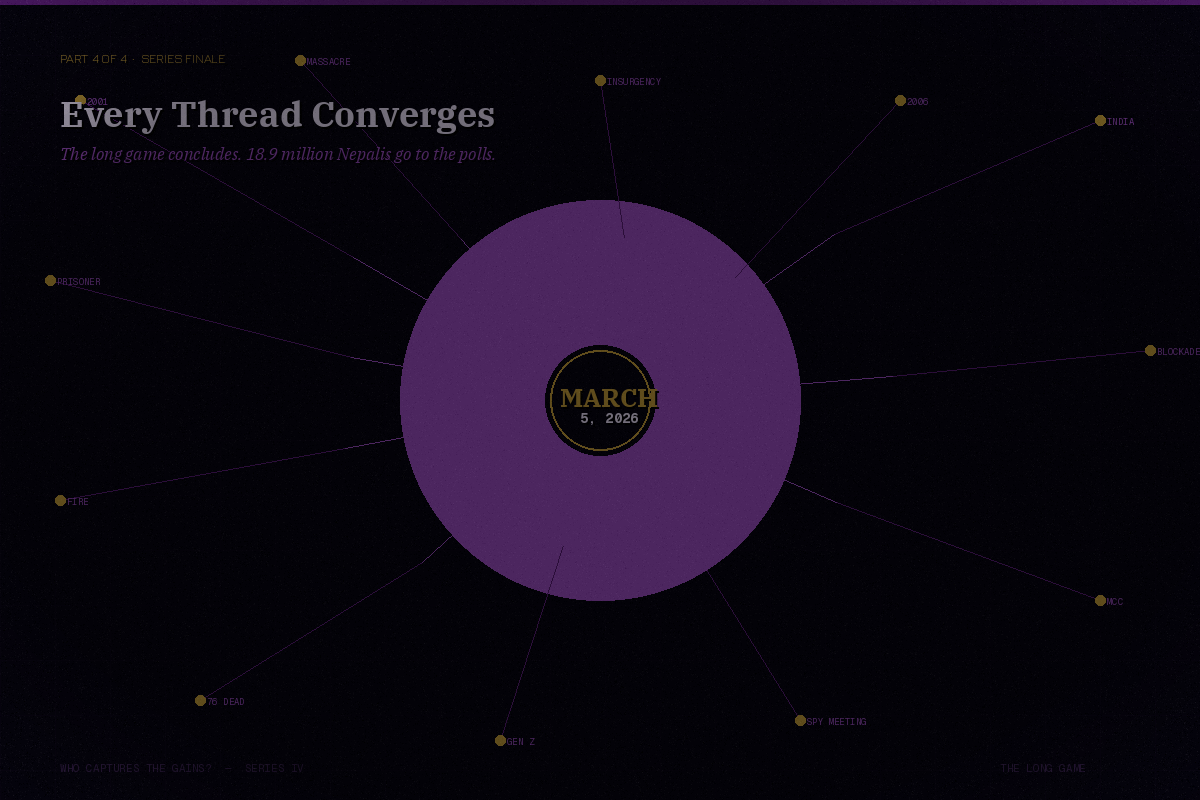
Every thread — the blockade, the $500 million wedge, the spy chief's secret meeting, the $900 million liberal ecosystem, the monarchist revival, the Gen Z uprising, the prisoner who walked free, the alliance designed to destroy but not govern, the revolution within the revolution — converges on a single date: March 5, 2026. This is the complete theory. The question: can you tell a perfect design apart from coincidence?
◀ Previously in this series
In Part 3, we documented the September 2025 uprising and the new political forces fighting for Nepal's future. Read Part 3 →
Nepal's revolutions have a pattern. They erupt from the bottom. They are captured from the top.
In 1950, the people rose against the Ranas. India's ambassador smuggled King Tribhuvan out on a military aircraft, and Delhi installed a friendly monarchy. In 1990, the people rose again. Politicians captured the parliament. In 2006, the Maoists and seven parties ended the monarchy. The same Maoists became the new establishment. In 2025, Gen Z burned it all down.
Every time, genuine rage. Every time, someone else collects the keys.
On September 4, 2025, KP Sharma Oli banned 26 social media platforms. Five days later, his government was in ashes — literally. Parliament burned. The Supreme Court burned. Singha Durbar burned. Oli fled to an army barracks. Within a week, Nepal had its first female Prime Minister, a dissolved parliament, and elections scheduled for March 5, 2026.
The official story is simple: Gen Z kids, fed up with corruption, changed history.
But what if the uprising — genuine as it was — was merely the final act of a play that began a decade earlier? What if every major event since 2015 has been structurally pushing Nepal toward one specific outcome?
This is not about whether the anger was real. It was. People died. Children were shot. The fury was authentic.
The question is: who built the channels through which that fury flowed?
Prologue: The Blueprint — India's 2015 Blockade
To understand September 2025, you have to go back to September 2015.
When Nepal's Constituent Assembly approved a new constitution on September 20, 2015 — 507 of 601 legislators voting yes — India didn't congratulate its neighbor. Instead, Indian Foreign Secretary S. Jaishankar flew to Kathmandu two days before promulgation to demand a delay. When Nepal ignored him, Ambassador Ranjit Rae proposed seven specific constitutional amendments.
Nepal said no.
What followed was economic warfare. India shut down the transit points through which 70% of Nepal's fuel flowed. Officially, it blamed Madhesi agitation at the border. Unofficially, Indian Oil Corporation, border police, and customs officials coordinated the embargo under what diplomatic cables described as "orders from above." The undeclared blockade lasted roughly four and a half months.
The damage was catastrophic. GDP growth plummeted to 0.2%. Private-sector losses hit Rs 202.5 billion — nearly $2 billion, roughly a quarter of the national budget. Hospitals ran out of medicine. Black-market petrol hit $5 per liter. UNICEF and Oxfam warned of a health crisis in a country still reeling from the April 2015 earthquake that had killed 9,000 people.
The blockade's political consequences were paradoxical — and this is where the pattern begins.
In the short term, it supercharged anti-India nationalism, which communist parties exploited far more effectively than the Nepali Congress. KP Sharma Oli rode the fury to the premiership in October 2015 and then to a landslide in 2017. Nepal pivoted hard toward China — signing a fuel deal with PetroChina, joining the Belt and Road Initiative in 2017, and watching Chinese FDI surge from 42% of total inward investment to 95% by early 2021.
India had overplayed its hand. As The Diplomat noted: "New Delhi has few friends left to help with the meddling."
But over the longer arc, the blockade established something more important than any single election result. It established a precedent: India would use economic leverage to constrain any Nepali government that moved too far from its orbit. This created permanent structural pressure on Nepal's communist parties, whose nationalist stance made them India's natural adversaries. The Nepali Congress — literally founded in India, with leaders who participated in India's independence movement — could always manage the relationship more smoothly.
The 2015 blockade didn't destroy the communists. It created the conditions under which their destruction would become possible.
Act I: The $500 Million Wedge — How the MCC Broke the Communist Party
If the blockade was India's hammer, the Millennium Challenge Corporation compact was America's scalpel.
The $500 million grant, signed September 14, 2017, ostensibly funded electricity transmission lines and road maintenance. Development aid. Nothing controversial.
Then, in May 2019, Acting Deputy Assistant Secretary David J. Ranz made a remark that changed everything. He called MCC "one of the most important initiatives being implemented in Nepal under the US Indo-Pacific Strategy."
With those words, a development grant became a geopolitical grenade — lobbed directly into the middle of Nepal's communist movement.
At the time, the Nepal Communist Party (NCP) was the most powerful political force in the country. Formed from the May 2018 merger of CPN-UML and CPN-Maoist Centre, it commanded 174 of 275 parliamentary seats — a near two-thirds majority. China's Communist Party had personally brokered the merger; CPC International Liaison Department Vice-Minister Guo Yezhou had negotiated the deal. Beijing envisioned a stable, China-friendly government for years to come.
The MCC debate cut the NCP in half. Oli's faction leaned toward ratification. The Dahal-Madhav Nepal faction opposed it as a US tool for containing China. An NCP task force concluded the compact was "closely linked to the US government's security goals and programs." One communist leader reportedly said privately: "If the MCC will be passed in Nepal, the Communist Party will cease to exist because the U.S. will never tolerate the word 'Communist.'"
The pressure campaign was anything but subtle. MCC Vice President Fatema Sumar visited Kathmandu in September 2021, pressing for ratification. Assistant Secretary Donald Lu arrived in November with an ultimatum: if Nepal didn't want the money, "we will spend it in some other country."
Then came February 10, 2022 — the date that should be studied in every political science classroom in South Asia. Lu made phone calls to Deuba, Oli, and Dahal with five explicit messages: the compact must be voted on, not merely tabled. No amendments were acceptable. Failure would trigger a review of US-Nepal relations, including cuts to bilateral and multilateral aid. Washington would interpret rejection as evidence of Chinese interference. And — the part that crossed every diplomatic red line — human rights and corruption issues could be "leveraged."
He reportedly told Dahal directly: "We will understand that China intervened and suspended our aid."
On February 27, 2022 — one day before the US deadline — Nepal's parliament ratified the MCC with an interpretive declaration that explicitly stated Nepal would not join any military alliance or the Indo-Pacific Strategy.
The man who drafted that declaration? Gagan Thapa. He framed it as pragmatism, not surrender. His famous parliamentary line: "Let's take Rs 60 billion from MCC. Then go to China and say, 'America has given us Rs 60 billion. Now give us Rs 70 billion under BRI.' Then go to India for Rs 80 billion."
The MCC passed. But the communist party that had tried to block it was already dead. The Supreme Court had annulled the NCP merger in March 2021 — going further than the original petition demanded. The petitioner had only challenged the party name; the court voided the entire merger. Then the Deuba government lowered the party-split threshold from 40% to 20%, directly enabling Madhav Kumar Nepal to form CPN (Unified Socialist) with just 29 lawmakers.
The NCP's 174 seats shattered into five competing parties. CPN-UML. CPN-Maoist Centre. CPN (Unified Socialist). CPN Unity National Campaign. People's Progressive Party. As the Observer Research Foundation concluded: "Had there been no splits in the NCP, the communists would have ruled the country for a long time."
The MCC didn't just pass a bill. It detonated the communist movement from within.
Act II: The Secret Meeting That Broke Everything
The NCP's unraveling wasn't just about policy disagreements. It was about midnight visits and intelligence operations.
By June 2020, 30 of 44 NCP Standing Committee members had demanded Oli's resignation. Then came a remarkable sequence of visitors.
On October 21, 2020, RAW chief Samant Kumar Goel flew to Kathmandu on an Indian Air Force aircraft. He held a two-to-three-hour secret meeting with Oli at Baluwatar — with no other Nepali official present. Indian Army Chief Gen. Naravane followed on November 4–5. Indian Foreign Secretary Shringla arrived November 25–26. China's Defense Minister Wei Fenghe appeared two days later — diplomatic tit-for-tat.
On December 20, 2020, Oli dissolved parliament.
Prachanda directly accused him of acting "at India's behest," citing the RAW chief's secret meeting. Chinese Ambassador Hou Yanqi rushed to meet President Bhandari, Dahal, and other leaders. Beijing dispatched Guo Yezhou's four-member delegation (December 27–30) to salvage unity. They failed. The factions had "declared a war on each other."
China's mediation failed for structural reasons that reveal the asymmetry of external influence. India had intelligence assets, economic leverage, an open border, and deep institutional penetration built over centuries. China had money, road projects, and goodwill — but no equivalent of RAW's grassroots network. When the crisis came, India could whisper in ears that mattered. China could only hold meetings.
Act III: $900 Million and the Liberal Ecosystem
While India worked through intelligence channels, the United States worked through institutional ones — and the scale is staggering.
USAID signed a $402.7 million Development Objective Agreement in May 2022. Combined with the $500 million MCC compact, total US commitments exceeded $900 million — roughly one-third of all development funding in Nepal. USAID Administrator Samantha Power specifically allocated $58.5 million "to advance democratic progress," including $18.5 million for independent civil society organizations and media.
The National Endowment for Democracy allocated $1,741,377 to Nepal in FY2024 alone, with grants explicitly targeting youth civic engagement, movement building, and media strategy. The International Republican Institute ran a $350,000 "Yuva Netritwa" (Youth Leadership) program training young Nepalis to advocate against Indian and Chinese influence — a framing that conveniently positioned the US as the neutral alternative. NDI deployed 6,000 election observers across 240 constituencies. The Asia Foundation led a $37 million Civil Society and Media Activity working with 56 local organizations.
The Open Society Foundations have operated in Nepal since 2006–07, funding independent journalism through networks reaching 170 radio stations. The Federation of Nepali Journalists itself receives NED and OSF funding. Personnel move fluidly between these organizations: The Asia Foundation's Nepal country representative Meghan Nalbo previously served as director of USAID Nepal's Democracy and Governance Office.
A British Council study found that an estimated 60–70% of local elected leaders from the 2017 elections had formal NGO experience.
This ecosystem didn't need to be directly partisan to reshape politics. It cultivated frames of human rights, inclusion, accountability, and liberal governance that aligned naturally with Congress's positioning and challenged the communist parties' state-centric, nationalist orientation. When a crisis hit, these frames would determine which direction the political energy flowed — toward liberal democracy, not communist consolidation.
Then, in 2025, the crisis hit.
Act IV: The Uprising That Was Too Perfect
Nepal's Gen Z protests erupted over a social media ban, but the fuel had been accumulating for years: 22.7% youth unemployment, 1,500 Nepalis fleeing daily for foreign labor, the viral #NepoKids movement exposing politicians' children living lavish lifestyles while families starved, and the firing of Kulman Ghising — the man who had ended Nepal's 18-hour daily power cuts and made the Nepal Electricity Authority profitable for the first time (Rs 14.5 billion profit in 2023–24) — from the NEA in March 2025, four months before his term expired, on contested grounds by the Oli government.
The protests were devastating and swift. Security forces fired 2,642 live rounds and 1,884 rubber bullets. A 12-year-old was among the first to die. At least 76 people were killed. The movement was organized through Discord servers with over 100,000 members — leaderless, decentralized, and furious.
But here's the first question.
Who did this uprising primarily destroy? Not the Nepali Congress. Not the liberal newcomers. It destroyed the communist-led government. KP Sharma Oli — communist. The communist apparatus that had produced 10 of Nepal's 14 Prime Ministers since 2008 took the direct hit.
Protest organizer Anil Baniya of Hami Nepal later said what many suspected: the movement was "hijacked by external forces and political party cadres." A professor's warning echoed: "We must never again outsource hope, agency or critical thinking to any self-proclaimed saviour."
And consider this: the Sunday Guardian reported that the US had funded a youth programme in Nepal specifically designed to "counter the influence of India and China." NED grants targeted "strengthening youth participation in advocacy and reform campaigns." When those youth finally mobilized, they mobilized against the communist government — not against the liberal establishment.
The revolution was real. The infrastructure that shaped its direction had been built over a decade.
Act V: The Ghost of the Palace — Nepal's Monarchist Revival
But here's where the story gets complicated. Because it wasn't just liberals and communists playing this game. There was a third force — one that nobody expected to return.
The monarchy.
King Gyanendra — deposed in 2008, still commanding an estimated $600–900 million fortune through stakes in 35-plus companies — spent years in quiet semi-retirement. Then, starting in late 2024, he escalated dramatically.
His October 2024 visit to Bhutan — receiving red-carpet treatment from King Jigme — triggered geopolitical speculation. On February 18, 2025, his video address on Democracy Day declared: "The people are tired of endless instability and corruption." On March 9, an estimated 10,000–15,000 supporters blocked Tribhuvan International Airport as he returned to Kathmandu, his car taking 2.5 hours to travel three miles through cheering crowds.
The Rastriya Prajatantra Party (RPP), Nepal's principal conservative force, had surged from near-irrelevance (one seat in 2017) to 14 seats in 2022 — fifth-largest party, recognized nationally for the first time. Chairman Rajendra Lingden reunified RPP with the Kamal Thapa-led RPP-Nepal on December 31, 2025, consolidating the monarchist vote under one banner. Their 2026 manifesto centers on constitutional monarchy restoration, Hindu state declaration, and replacing federalism with a two-tier governance structure.
Senior Vice-Chairman Rabindra Mishra — the former BBC Nepali Service editor — was arrested in March 2025 after violent pro-monarchy protests at Tinkune left two dead and 45 injured. The Supreme Court ordered his release in May. He contests Kathmandu-1, where he lost by just 125 votes in 2022.
The Hindu Rashtra issue has penetrated far deeper than the monarchy question. A December 2024 nationwide survey found 51.7% of Nepalis support declaring Nepal a Hindu state — a cross-cutting demand that reaches inside every party, including nearly half of Congress's own Mahasamiti members. Even Oli — a communist — donated 104 kg of gold to Pashupatinath Temple and announced construction of a Ram Janaki temple during his tenure. Senior Congress leaders Shekhar Koirala and Shashank Koirala have publicly endorsed the Hindu state position.
The Indian connection is the explosive dimension. The US State Department's 2022 International Religious Freedom Report stated that "right-wing religious groups associated with the BJP in India continued to provide money to influential politicians of all parties in Nepal to advocate Hindu statehood." India's RSS affiliate Hindu Swayamsevak Sangh operates over 1,048 Ekal Vidyalayas in Nepal. The Vishwa Hindu Parishad has organized mass reconversion events — 2,000 Christians reconverted in Sunsari district in August 2024 alone. UP Chief Minister Yogi Adityanath addressed 10,000 people in Kathmandu demanding Hindu state restoration, and his posters appeared at pro-monarchy rallies as recently as March 2025.
When Nepal's Foreign Minister directly asked India's Jaishankar about Indian support for the monarchist movement, "Jaishankar categorically denied it." Then India facilitated the arrest of monarchist firebrand Durga Prasai in Assam — delivering a blow to claims of Indian backing.
So what game is India playing? Veteran journalist Kanak Mani Dixit captured it: "India's Nepal policy is scattered across various points in the Indian hierarchy with the right hand not knowing what the left hand does... intelligence wallahs and now even Hindutva wallahs seem to be calling the shots."
Here's how the monarchist movement fits the larger theory: RPP doesn't need to win. It needs to fragment. RPP draws from culturally conservative, upper-caste, hill-region voters who overlap significantly with UML's base. Every seat RPP takes is a seat UML loses. In 2022, communist parties "suffered huge losses, losing more than 30 percent of their seats" while "monarchist and new parties increased their vote share significantly."
The monarchists are fielding candidates in 163 of 165 constituencies — independently, having declared their 2022 alliance with UML "a mistake." Their target: triple from 14 seats to around 42. That's 42 seats that would otherwise, in large part, go to communist candidates.
RPP is the second wrecking ball. RSP demolishes the communist youth vote from the left. RPP demolishes the communist conservative vote from the right. And standing in the center, untouched by either demolition, is Nepali Congress.
Act VI: The Prisoner Who Walked Free
Rabi Lamichhane is Nepal's most contradictory political figure — a celebrity journalist who held a Guinness World Record, founded a party five months before elections, won 20 seats, served as Deputy PM twice, and then ended up in prison on fraud, organized crime, and money laundering charges across five districts.
When Gen Z protesters stormed institutions in September 2025, Lamichhane was freed from prison. He voluntarily returned four days later — masterful theater. By December 2025, he was out on bail.
Now here's what's suspicious.
When Lamichhane was released, social media exploded with outrage. The very same Gen Z voices that toppled a government screamed: "We did not do this movement to make Rabi Lamichhane PM!"
But fast forward just a few weeks, and something remarkable happened. The outrage evaporated. The same activists who were furious went quiet. Then they started appearing at RSP rallies. Then they started actively campaigning.
What changed? Nothing about Lamichhane's legal situation changed. The charges didn't disappear. Yet suddenly, opposition transformed into acceptance and then active support.
Someone, somewhere, flipped a switch.
On December 28, 2025, the political bomb dropped. Balen Shah — the 35-year-old rapper-engineer mayor of Kathmandu, Time Magazine honoree, darling of Gen Z — signed a seven-point unity agreement with Lamichhane's RSP. Balen became the party's Prime Ministerial candidate. Lamichhane remained party chair.
On paper, this is a revolutionary alliance. In practice, it's a carefully constructed dead end.
Consider the math. Balen Shah is 35, has zero parliamentary experience, has never managed anything larger than a municipal government, and his popularity is concentrated in Kathmandu's urban bubble. His own party admits his appeal may not extend to Madhesh or rural Nepal, where elections are won. He is running against Oli in Jhapa-5 — a symbolic battle designed to generate headlines, not necessarily to produce a Prime Minister.
Rabi Lamichhane faces active criminal prosecution across five districts. Even on bail, he remains suspended from parliament. Legal experts confirm he can contest elections, but becoming PM while facing organized crime charges would be politically untenable. Every foreign embassy, every international organization, every lending institution would question the legitimacy of a government led by someone under criminal investigation.
Kulman Ghising — the technocrat who ended Nepal's power outages and was enormously popular — briefly joined the RSP alliance, then pulled his Ujyaalo Nepal Party away to contest independently. Why? What did he see that made him walk away?
The alliance is designed to be strong enough to destroy the communist vote but not strong enough to actually govern.
RSP is fielding candidates in 164 of 165 constituencies. They will split the anti-establishment vote. They will peel away urban youth from UML and Congress alike. But in Nepal's parliamentary system, winning scattered seats doesn't make you PM. Forming a majority coalition does.
And who is best positioned to form that coalition after the dust settles?
Act VII: The Revolution Within the Revolution
While the world watched Balen and Rabi, something equally dramatic happened inside Nepali Congress.
Gagan Thapa — 49 years old, articulate, liberal, World Economic Forum Young Global Leader (2015), board member of The Parliamentary Network connecting legislators with the World Bank, contributor to The New York Times and The Lancet, member of Liberty International — launched what can only be described as a hostile takeover of Nepal's oldest party.
At a special convention in January 2026, he seized the presidency from 79-year-old Sher Bahadur Deuba — four-time Prime Minister, the man who abolished the monarchy, the patriarch of Nepali Congress.
Thapa immediately unveiled the "Janakpur Declaration" — a public apology to Gen Z youth and a "10-point Contract with the People." He strategically moved his constituency from Kathmandu to Sarlahi-4 in Madhesh Province, signaling a national, not just urban, coalition.
The timing is surgical. After the uprising discredited the old guard. Before the campaign began. Fresh face, established machinery.
Now trace his trajectory backward through everything we've documented:
He was the most vocal advocate for MCC ratification — personally drafting the interpretive declaration that allowed it to pass. He simultaneously opposed the SPP military program, preserving nationalist credentials. He called Rabi Lamichhane a "cooperative thug" in parliament — the most vocal demander of the investigation that eventually jailed his primary rival. He was elected Congress General Secretary with the highest vote count (3,023) in December 2021. He conducted Congress's internal revolution at exactly the moment when the party's old guard was discredited but its organizational machinery remained intact.
His education is entirely domestic — BSc in Chemistry, MA in Sociology from Tribhuvan University. No Western degrees. No documented IVLP participation. Just enough deniability.
But his networks tell a different story. WEF Young Global Leader — a network whose alumni include Emmanuel Macron, Jacinda Ardern, and Mark Zuckerberg. Parliamentary Network board. Liberty International member. The Diplomat notes he "has more credibility with foreign powers, India most crucially."
He represents exactly the kind of leader that both India and the United States would prefer in Kathmandu — someone who would maintain the MCC, deepen ties with Delhi, and keep Beijing at a manageable distance. He is the anti-Oli in every sense.
Act VIII: The Elimination Game
Now connect every dot — not just from 2025, but from 2015.
Phase 1 (2015–2017): Establish the pressure framework. India's blockade demonstrated economic leverage. The MCC compact was signed. Western NGO infrastructure expanded massively.
Phase 2 (2018–2021): Break the communist supermajority. The NCP's 174-seat bloc was fractured through the MCC wedge, the RAW chief's secret meeting, Oli's parliament dissolution, the Supreme Court's unusual decision to void the entire merger, and the Deuba government's lowering of the split threshold. China tried and failed to hold the bloc together.
Phase 3 (2022): Establish the spoiler parties. RSP emerged five months before elections, won 20 seats — six from communist strongholds. RPP surged to 14 seats. The communist vote bled in two directions simultaneously.
Phase 4 (2023–2025): Amplify the conservative wildcard. The pro-monarchy movement surged, supported by India's Sangh Parivar infrastructure at the grassroots. The Hindu Rashtra debate penetrated every party. RPP reunified under Lingden. Meanwhile, Rabi Lamichhane was arrested and jailed — with Gagan Thapa as the loudest voice demanding prosecution.
Phase 5 (September 2025): The final demolition. The Gen Z uprising destroyed the Oli government. Communist parties fragmented further. Nine parties merged into a new NCP under Prachanda — but without UML, ensuring the left remained split.
Phase 6 (January 2026): Install the candidate. Thapa seizes Congress leadership, presents himself as the post-revolutionary leader, and enters the March election as the only viable PM candidate.
Now let's eliminate the competitors the way the game appears designed:
- CPN-UML (Oli): Damaged by the uprising, membership dropped from 855,000 to 650,000. Oli is 73, carries the "dictator" label. Bleeds votes to RSP from the left and RPP from the right. Enters as the establishment villain.
- NCP/Maoist bloc (Prachanda): Nine parties merged but without UML. The communist vote is permanently split. Prachanda is 71, has switched alliances five times. Fading relevance.
- RSP (Balen/Rabi): Massive youth energy but fatal structural weaknesses. Balen has no parliamentary experience. Rabi has criminal cases. Neither can credibly become PM. They win seats but not a majority.
- RPP (Lingden): Reunified but still marginal at 5–6% of the vote. Monarchy restoration requires a two-thirds majority plus referendum — constitutionally near-impossible. Their real function: bleeding UML's conservative base while the Hindu Rashtra demand creates noise without resolution.
That leaves one man standing: Gagan Thapa.
Congress has the organization, the institutional memory, and the post-election coalition mathematics. Even without the most seats, it is best positioned to assemble a governing majority — potentially with RSP support, since both occupy the liberal democratic space. No party will win the 137-seat majority, making coalition arithmetic everything.
Thapa becomes PM not because he wins a landslide, but because everyone else has been eliminated through a decade of structural engineering.
The Counter-Arguments: Why This Could All Be Wrong
Every theory deserves its strongest challenge.
The communists destroyed themselves. This is substantially true. Oli and Prachanda's egos shattered their merger. The coalition carousel of 2022–2025 was entirely self-inflicted. No foreign agency forced Prachanda to switch allies five times. Academic Santa Bahadur Thapa's assessment is precise: "As long as Nepal's two neighbors, India and China, have a strategy to keep Nepal's communist parties under their influence, there is no possibility of communist parties becoming one party." But internal factionalism predates external pressure by decades.
RSP hurts Congress too. If external forces wanted Thapa, why strengthen a party that competes for the same liberal voters? Unless RSP's primary function is demolishing the communist urban youth vote — acting as wrecking ball, not builder. Once demolition is complete, RSP doesn't need to win. It fragments the opposition enough that Congress emerges as the largest party.
The monarchist movement is genuinely popular. 51.7% support Hindu state. Large rallies. Real nostalgia. Genuine movements can still be structurally useful to external actors. India's Sangh Parivar infrastructure amplifies a movement that would exist anyway — just enough to hurt communist parties at the ballot box.
$900 million in US funding doesn't prove orchestration. True. Development aid serves legitimate purposes. But the ecosystem it built — 60–70% of local leaders with NGO backgrounds, a media landscape funded by NED and OSF, youth programs designed to "counter influence" — meant that when crisis hit, political energy naturally flowed toward liberal-democratic channels. That's not conspiracy. It's something more sophisticated: an environment engineered so that revolutions always flow in one direction.
The Gen Z movement explicitly rejected manipulation. Also true. They rejected monarchy. They rejected party capture. But rejecting manipulation doesn't mean you weren't positioned. The most effective influence operations are the ones the target never detects.
Internal weakness creates vulnerability. External forces exploit that vulnerability. The two explanations aren't mutually exclusive. They're complementary.
The Final Twist
Here's what nobody is talking about.
If Gagan Thapa becomes PM after March 2026, he will be Nepal's most consequential liberal leader in decades. He would deepen ties with India, maintain and expand the MCC, welcome greater US engagement, keep China at a distance, and resist the Hindu Rashtra demands that threaten Nepal's secular constitution — all while carrying the democratic legitimacy of a post-revolution mandate.
The communist movement — which dominated Nepali governance for nearly two decades, toppled the monarchy, fought a civil war, and wrote the constitution — would be reduced to a fractured opposition. Not destroyed. Not banned. Just… irrelevant.
The monarchists — who mobilized 20,000 people on Republic Day — would remain a noisy but contained minority, their Hindu Rashtra demands acknowledged with symbolic gestures but never constitutional amendments. RPP might even be invited into a junior coalition role, neutralizing its disruptive potential while denying it real power.
And the truly elegant part? Nobody pulled a trigger. Nobody organized a coup. Nobody bribed a general. A genuine economic blockade created pressure. A genuine aid program built infrastructure. Genuine personality conflicts broke a party. A genuine uprising toppled a government. Genuine youth anger demanded change.
It's just that the harvest was planned before the seed was planted.
Or maybe not. Maybe Gagan Thapa simply seized his moment, like every ambitious politician does. Maybe Balen and Rabi genuinely believe they can govern. Maybe the communists really did destroy themselves through corruption and ego. Maybe the monarchists represent honest nostalgia for stability. Maybe India's right hand truly doesn't know what its left hand does. Maybe Nepal's Gen Z kids simply wanted a better country and everything that followed was the messy, unplanned consequence of democratic upheaval.
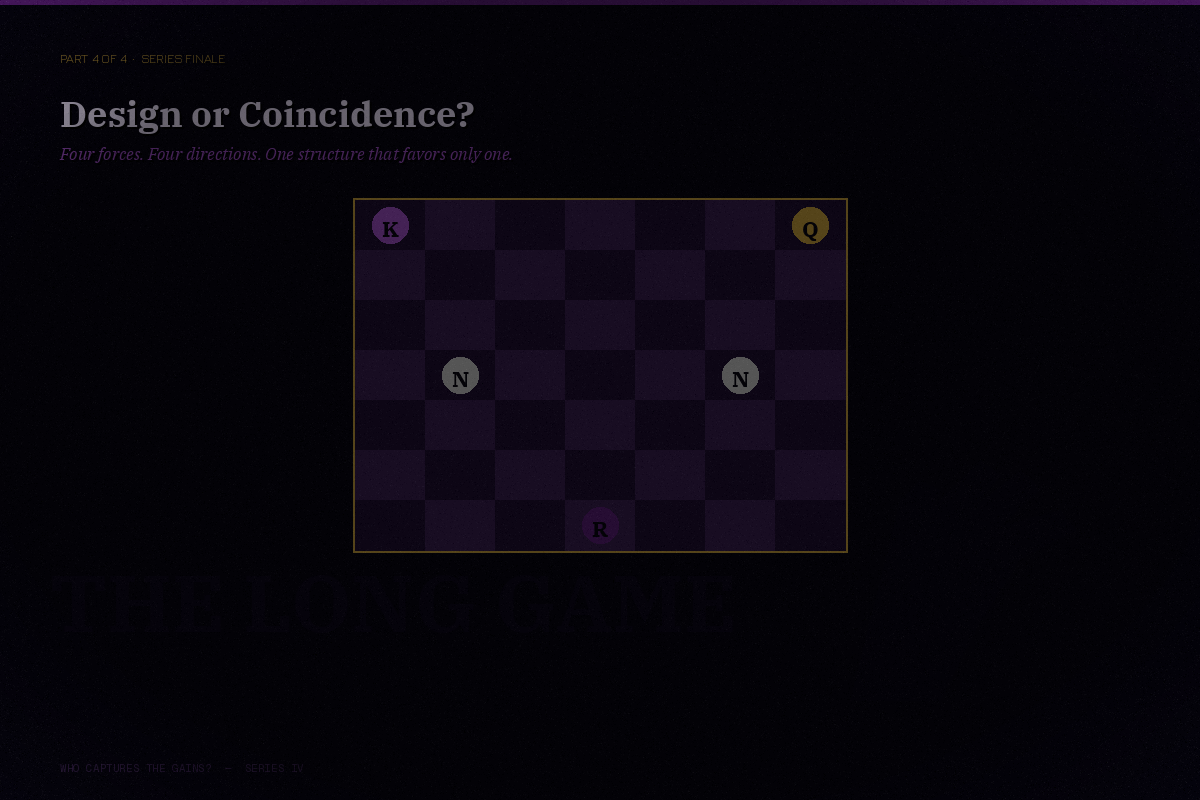
That's the beauty of a perfect design. You can never quite tell it apart from coincidence.
Epilogue: What to Watch on March 5, 2026
The election results will be the ultimate verdict.
- If Congress wins big and Gagan Thapa becomes PM while RSP underperforms and RPP bleeds enough from UML to prevent communist recovery — the theory gains enormous weight.
- If RSP actually forms a government with Balen as PM, the theory partially collapses. The spoiler became the replacement, and the engineering failed.
- If UML somehow recovers and Oli returns, then all theories were wrong and Nepal's political physics — where nothing ever truly changes — would have reasserted itself.
- If RPP crosses 30+ seats and demands monarchy restoration as coalition price, the conservative wildcard would complicate every calculation.
- If the new NCP (Prachanda's nine-party merger) performs strongly, it would mean the communists finally learned from their fratricide — and decades of external pressure failed to permanently shatter the left.
Nepal has been here before. 1950 — the people rose, India captured the gains. 1990 — the people rose, politicians captured the gains. 2006 — the people rose, Maoists-turned-politicians captured the gains. 2025 — the people rose again.
This time, the game board is crowded: liberals, communists, monarchists, populists, and a generation that trusts none of them. The channels have been built. The candidates have been positioned. The spoilers have been deployed. Five forces are pulling in five directions, and the structure favors only one.
The question that defines Nepal's future: This time, who captures the gains?
Watch the throne. The answer may already be written — in $900 million worth of ink.
This article presents a political theory connecting publicly available facts, documented events, and credible analysis spanning 2015–2026. It traces a convergent pattern of Indian intelligence operations, US democracy-promotion infrastructure, communist self-destruction, monarchist resurgence, and liberal positioning — and argues the cumulative effect has structurally advantaged one specific political outcome. Whether this constitutes deliberate orchestration, alignment of interests, or coincidence is the central unresolvable question. The author does not claim definitive proof of coordination but argues the evidence warrants serious public scrutiny. Nepal's voters will deliver the final verdict on March 5, 2026.
END OF SERIES